Blog
How to Calculate the Surface Area of a Hemisphere
A clear calculation method for curved and total hemisphere surface area on paper or with a browser tool.

Blog
A clear calculation method for curved and total hemisphere surface area on paper or with a browser tool.
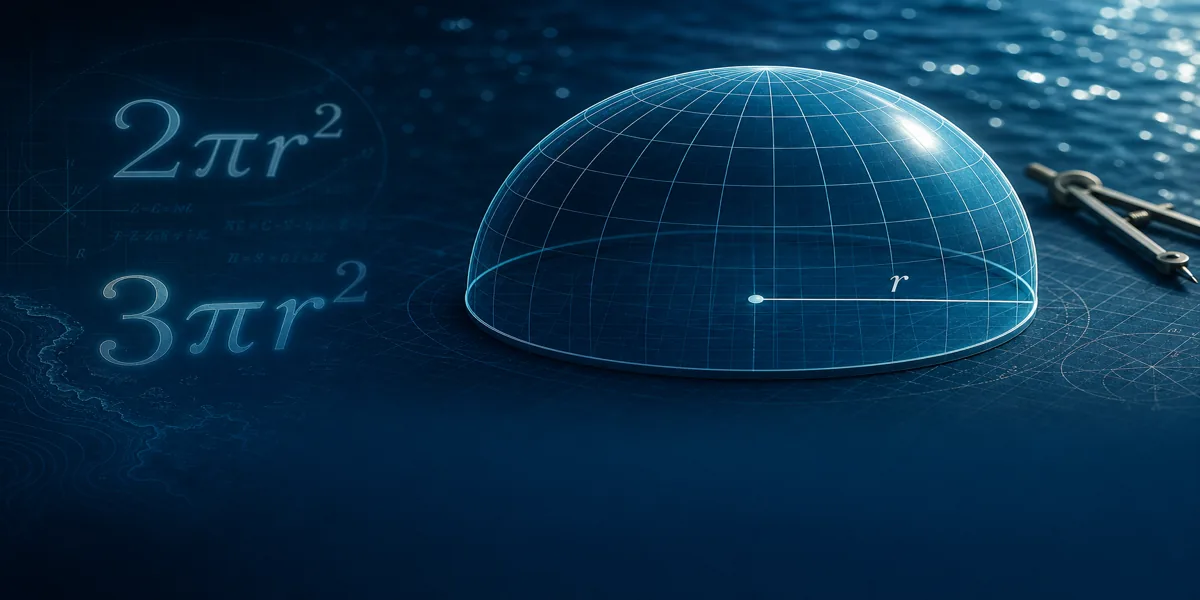
Measure r, choose CSA = 2πr² or TSA = 3πr², compute, and label square units.
Formula
Surface Area of a Hemisphere Calculator runs the arithmetic instantly, yet instructors still want you to show a logical sequence on tests.
This method works for homework, lab reports, quick field notes, and design checks before you order material.
The same steps apply whether you start from radius, diameter, or a stated total area on a spec sheet.
Word problems hide the choice in phrases like "lateral area," "curved surface," or "total surface including the base." Underline those words before you substitute.
Manufacturing drawings may list diameter across the circular edge while math class problems give radius directly. Convert early so you do not square the wrong value.
The hemisphere formula reference lists CSA and TSA side by side when you need a notation reminder mid-calculation.
After your first manual run, scan worked hemisphere examples to see how the same steps appear at different scales.
Use this checklist each time you calculate hemisphere surface area.
A tank head diagram lists diameter 14 ft across the base. Radius r = 7 ft.
For total exterior surface including the base: TSA = 3π(7)² = 3π(49) = 147π ≈ 461.81 ft².
If only the curved cap is coated, CSA = 2π(49) = 98π ≈ 307.88 ft² instead.
Stating both values on your worksheet shows you understood the difference even when the final answer uses only one.
Measure radius, pick CSA or TSA, substitute, and label square units every time.
Keep curved and total answers separate when a drawing could need both quotes.
Hemisphere volume (2/3)πr³ and surface area formulas together: dimensional analysis, surface-to-volume ratio, examples, and how the calculator links both.
Calculate hemisphere surface area from diameter: convert to radius, use CSA and TSA formulas, worked examples, and field measurement accuracy tips.
Compare hemisphere and sphere surface area and volume: 4πr² vs 2πr² and 3πr², key differences, side-by-side examples, and common misconceptions.