Blog
Volume and Surface Area of a Hemisphere
Volume and surface area answer different questions but share the same radius on a hemisphere.

Blog
Volume and surface area answer different questions but share the same radius on a hemisphere.
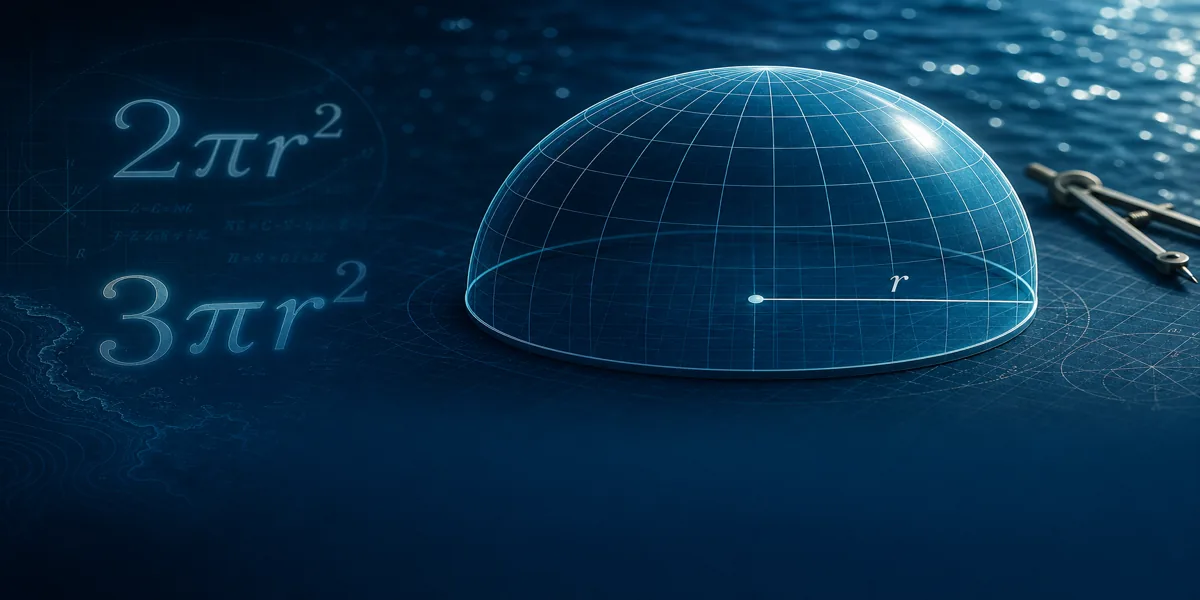
V = (2/3)πr³. CSA = 2πr². TSA = 3πr².
Formula
Surface Area of a Hemisphere Calculator shows volume alongside curved surface area, total surface area, and surface-to-volume ratio.
A bowl might need volume for capacity and surface area for glaze. A tank head might pair fluid volume with exterior coating.
This article keeps the formulas separate while showing how they link through r.
Packaging design may ask how much liquid a hemispherical bowl holds (volume) and how much glaze covers it (surface area).
Engineering estimates might list fluid volume in a head plus paint area on the outside. Write each formula on its own line.
If only volume is given, solve r = ∛(3V/(2π)) before surface area. The calculator accepts volume as a starting input.
For total exterior quotes, combine this page with total surface area of a hemisphere so the base is included when needed.
Volume measures space inside the shape. Surface area measures the outside shell. You cannot interchange their units.
Surface-to-volume ratio using total surface area is 9/(2r). Smaller radii produce larger ratios at an introductory level.
When a worksheet compares shapes, read hemisphere versus sphere for surface and volume differences together.
r = 4 units: V = (2/3)π(64) ≈ 134.04 cubic units.
CSA ≈ 100.53 square units. TSA ≈ 150.80 square units.
Ratio TSA/V ≈ 9/(2×4) = 1.125 per unit length at this size, using total surface area in the numerator.
Changing only the surface type while keeping r fixed alters area but not volume.
Use volume for capacity and surface area for exterior coverage. Keep formulas and units separate on every line.
The home calculator displays both families of results from one starting measurement.
Calculate hemisphere surface area from diameter: convert to radius, use CSA and TSA formulas, worked examples, and field measurement accuracy tips.
Compare hemisphere and sphere surface area and volume: 4πr² vs 2πr² and 3πr², key differences, side-by-side examples, and common misconceptions.
Total surface area of a hemisphere (3πr²): includes the circular base plus the curved cap, formula derivation, CSA comparison, and worked examples.