Blog
Hemisphere Surface Area from Diameter
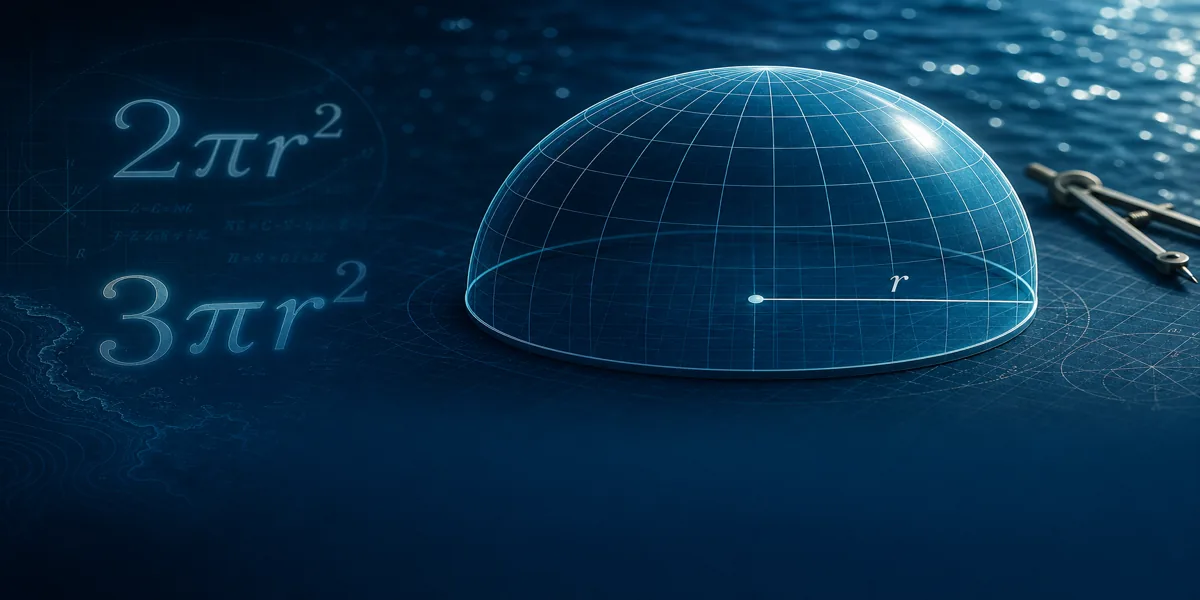
How to find hemisphere curved and total surface area when the only measurement you have is diameter.

Blog
How to find hemisphere curved and total surface area when the only measurement you have is diameter.
r = d/2. CSA = (πd²)/2. TSA = (3πd²)/4.
Formula
Surface Area of a Hemisphere Calculator lets you type diameter directly while it updates radius and every surface field.
Field notes and architectural plans often quote diameter across the open base because it is easy to measure with a tape.
This guide shows the conversion path and formula forms that skip a separate radius line on paper.
Tape measures introduce small error. For coating estimates, round conservatively or use the calculator to test a range.
If a drawing lists inner and outer diameter, confirm which one defines the geometric model before you square.
Unit consistency matters: convert mixed inches and feet before you halve and square.
After you convert, the calculation checklist still applies for choosing CSA versus TSA.
Halve the diameter before you square if you use the radius forms. A percentage calculator can help with related calculations. Squaring diameter without dividing by two is a common error.
Measure diameter across the widest part of the circular base, perpendicular to the axis of symmetry, for a consistent r.
Pair this page with the hemisphere surface area formulas when you want to see the same relationships written with r instead of d.
Short path from a single diameter measurement.
d = 20 cm gives r = 10 cm. TSA = 3π(100) = 300π ≈ 942.48 cm².
d = 14 ft gives r = 7 ft. CSA = 2π(49) = 98π ≈ 307.88 ft² when only the cap is coated.
Using the formula CSA = πd²/2 on the 20 cm case: π(400)/2 = 200π, matching the radius route.
Convert diameter to radius, choose CSA or TSA, and keep units straight from start to finish.
Hemisphere volume (2/3)πr³ and surface area formulas together: dimensional analysis, surface-to-volume ratio, examples, and how the calculator links both.
Compare hemisphere and sphere surface area and volume: 4πr² vs 2πr² and 3πr², key differences, side-by-side examples, and common misconceptions.
Total surface area of a hemisphere (3πr²): includes the circular base plus the curved cap, formula derivation, CSA comparison, and worked examples.