Blog
Surface Area of a Hemisphere Formula
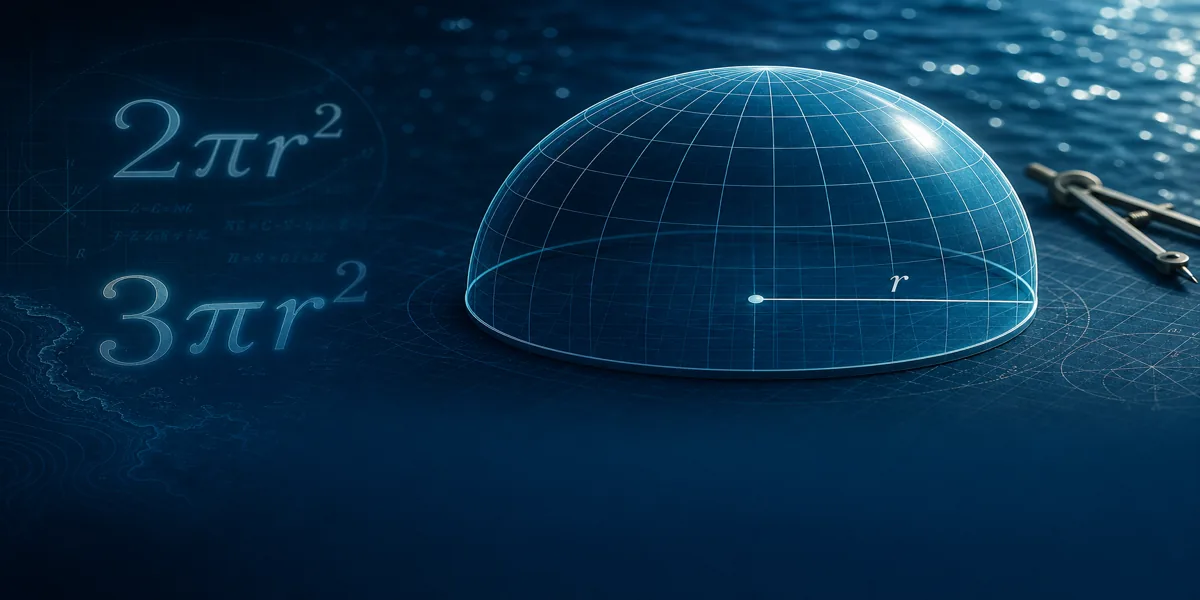
The hemisphere surface area formulas express curved shell area and full exterior area using the radius.

Blog
The hemisphere surface area formulas express curved shell area and full exterior area using the radius.
CSA = 2πr². TSA = 3πr². Base = πr².
Formula
Surface Area of a Hemisphere Calculator applies CSA = 2πr² and TSA = 3πr² whenever you enter radius, diameter, or a related value.
Students often memorize the symbols before they understand why the curved part is 2πr² instead of πr². This article connects each formula to the shape.
You will also see how radius scaling affects both curved and total results on engineering sketches.
Think of CSA as half of the orange peel on a full sphere. Think of TSA as that peel plus the flat slice face.
Radius is the single dimension that drives every result. Diameter d relates through r = d/2.
Some sheets list total surface area directly. You can solve r = √(TSA / (3π)) when you need to back into a radius from a coating spec.
For dome-only coatings, compare your result with the curved surface area guide so you do not add the base by habit.
A sphere of radius r has surface area 4πr². Cutting it in half leaves a curved cap with half that shell: 2πr².
The flat cut is a circle with area πr². Total surface area adds the cap and base: 2πr² + πr² = 3πr².
If you double the radius, each area quadruples because r is squared. That scaling rule matters when comparing two dome sizes on a bid.
New to the vocabulary? Start with what hemisphere surface area means before you rearrange formulas for homework.
Given r = 6 in, CSA = 2π(36) = 72π ≈ 226.19 in².
TSA = 3π(36) = 108π ≈ 339.29 in².
The base alone is 36π ≈ 113.10 in², which is exactly the difference between TSA and CSA.
Use 2πr² for the curved cap and 3πr² when the base belongs in the total exterior.
Match the formula to the wording of the task, then verify on the home calculator.
Hemisphere volume (2/3)πr³ and surface area formulas together: dimensional analysis, surface-to-volume ratio, examples, and how the calculator links both.
Calculate hemisphere surface area from diameter: convert to radius, use CSA and TSA formulas, worked examples, and field measurement accuracy tips.
Compare hemisphere and sphere surface area and volume: 4πr² vs 2πr² and 3πr², key differences, side-by-side examples, and common misconceptions.