Blog
Surface Area of a Hemisphere vs Sphere
How hemisphere curved and total surface area compare with the surface area of a full sphere.

Blog
How hemisphere curved and total surface area compare with the surface area of a full sphere.
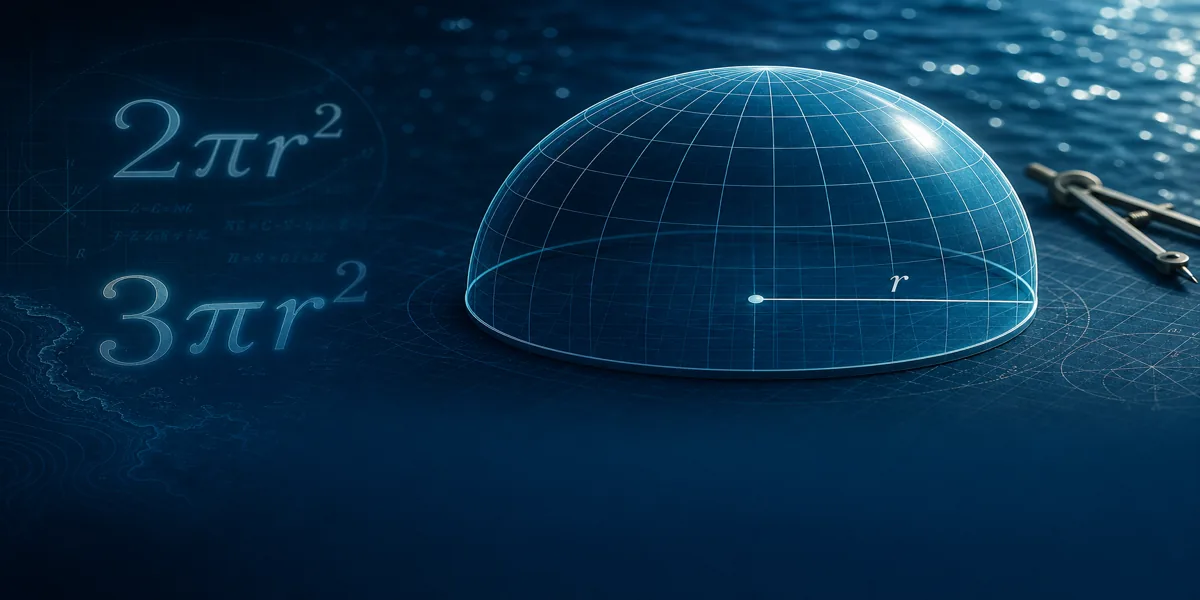
Sphere surface = 4πr². Hemisphere CSA = 2πr². Hemisphere TSA = 3πr².
Formula
Surface Area of a Hemisphere Calculator handles hemisphere math. This page contrasts those results with a complete sphere of the same radius.
The comparison helps you pick the right formula when diagrams on one worksheet show both shapes.
Keep surface area questions separate from volume questions even when both use the same r.
A sphere has no flat face. Its entire outer area is 4πr².
A hemisphere removes half of that shell for the curved cap (2πr²) and may add a flat base πr² when total surface is needed.
Volume differs too: sphere (4/3)πr³ versus hemisphere (2/3)πr³. Do not substitute one volume formula for the other.
A common misconception is calling TSA "half of a sphere surface." The curved part is half, but TSA is larger than half because of the base.
Focus on cap-only jobs with curved surface area before you compare numbers to a full sphere.
When a tank problem also lists capacity, open volume and surface area of a hemisphere for paired formulas.
r = 5: sphere surface ≈ 314.16. Hemisphere CSA ≈ 157.08 (half the sphere shell). Hemisphere TSA ≈ 235.62.
Notice TSA is greater than half of 314.16 because the base adds 78.54 square units.
If a problem gives sphere surface and asks for hemisphere CSA, divide the sphere result by two when the radius matches.
Match the shape first, then choose 4πr², 2πr², or 3πr².
Keep volume formulas on a separate line to avoid mixed-up exam answers.
Hemisphere volume (2/3)πr³ and surface area formulas together: dimensional analysis, surface-to-volume ratio, examples, and how the calculator links both.
Calculate hemisphere surface area from diameter: convert to radius, use CSA and TSA formulas, worked examples, and field measurement accuracy tips.
Total surface area of a hemisphere (3πr²): includes the circular base plus the curved cap, formula derivation, CSA comparison, and worked examples.