Blog
Surface Area of a Hemisphere Examples
Multiple worked examples for curved and total hemisphere surface area at classroom and field scales.

Blog
Multiple worked examples for curved and total hemisphere surface area at classroom and field scales.
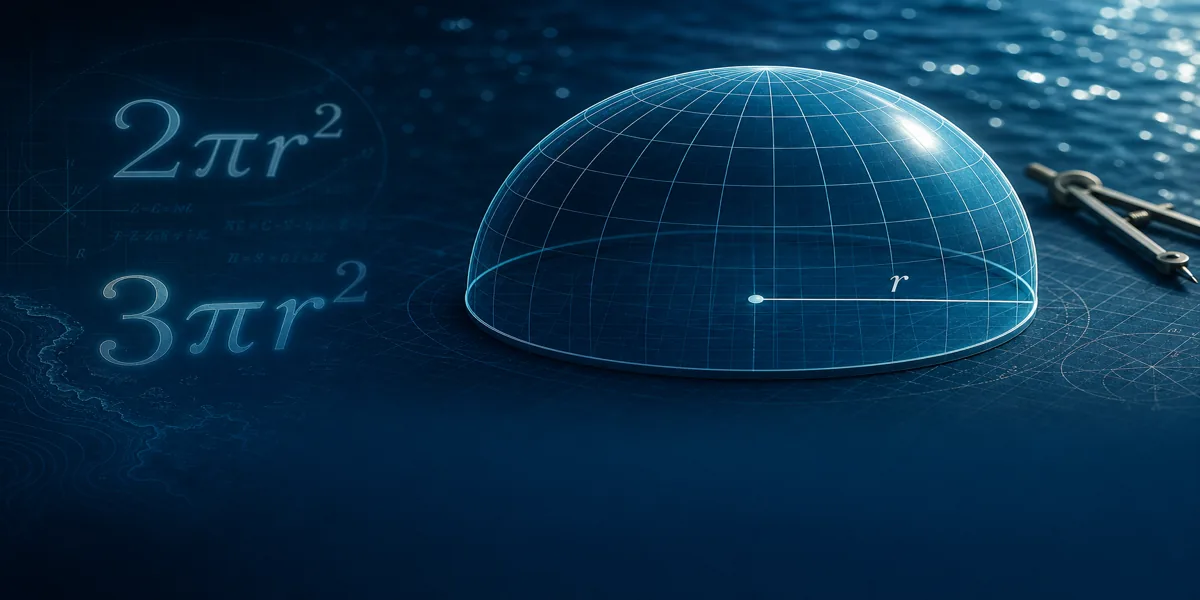
Use CSA = 2πr² for the cap only and TSA = 3πr² when the base is part of the exterior.
Formula
Surface Area of a Hemisphere Calculator confirms each result below, but walking through the algebra builds exam confidence.
Examples are grouped by size and by context so you can copy the pattern onto new numbers.
Every case states whether the base is included, because that choice changes the final square units.
Each line shows radius first, then curved surface area, then total when the base matters.
Construction and engineering samples use feet or meters. Classroom sets often use neutral "units" so you focus on structure.
If a prompt is still vague, review what hemisphere surface area measures before you copy a number from this page.
When your starting measurement is a diameter from a site sketch, switch to the surface area from diameter walkthrough for conversion tips.
All examples above flow from the same two surface formulas. Volume appears only when a multi-part problem also asks for capacity.
Small radius r = 2 units: CSA = 8π ≈ 25.13. TSA = 12π ≈ 37.70. Good for quick homework checks.
Education set with diameter 10: r = 5. CSA = 50π ≈ 157.08. TSA = 75π ≈ 235.62.
Construction dome r = 12 ft: CSA = 288π ≈ 904.78 ft² for cap coating. TSA = 432π ≈ 1357.17 ft² if the base flange is included.
Engineering reverse: total surface area 300 m² implies r = √(300/(3π)) ≈ 5.64 m. CSA at that radius is about 200 m².
Manufacturing note: if only the cap is machined and the base mounts flush, quote CSA. If the part ships as a visible solid hemisphere, quote TSA.
Pick the example closest to your scale, substitute your radius, and label CSA or TSA clearly.
Use the calculator to verify decimals after you show exact π form on paper.
Hemisphere volume (2/3)πr³ and surface area formulas together: dimensional analysis, surface-to-volume ratio, examples, and how the calculator links both.
Calculate hemisphere surface area from diameter: convert to radius, use CSA and TSA formulas, worked examples, and field measurement accuracy tips.
Compare hemisphere and sphere surface area and volume: 4πr² vs 2πr² and 3πr², key differences, side-by-side examples, and common misconceptions.